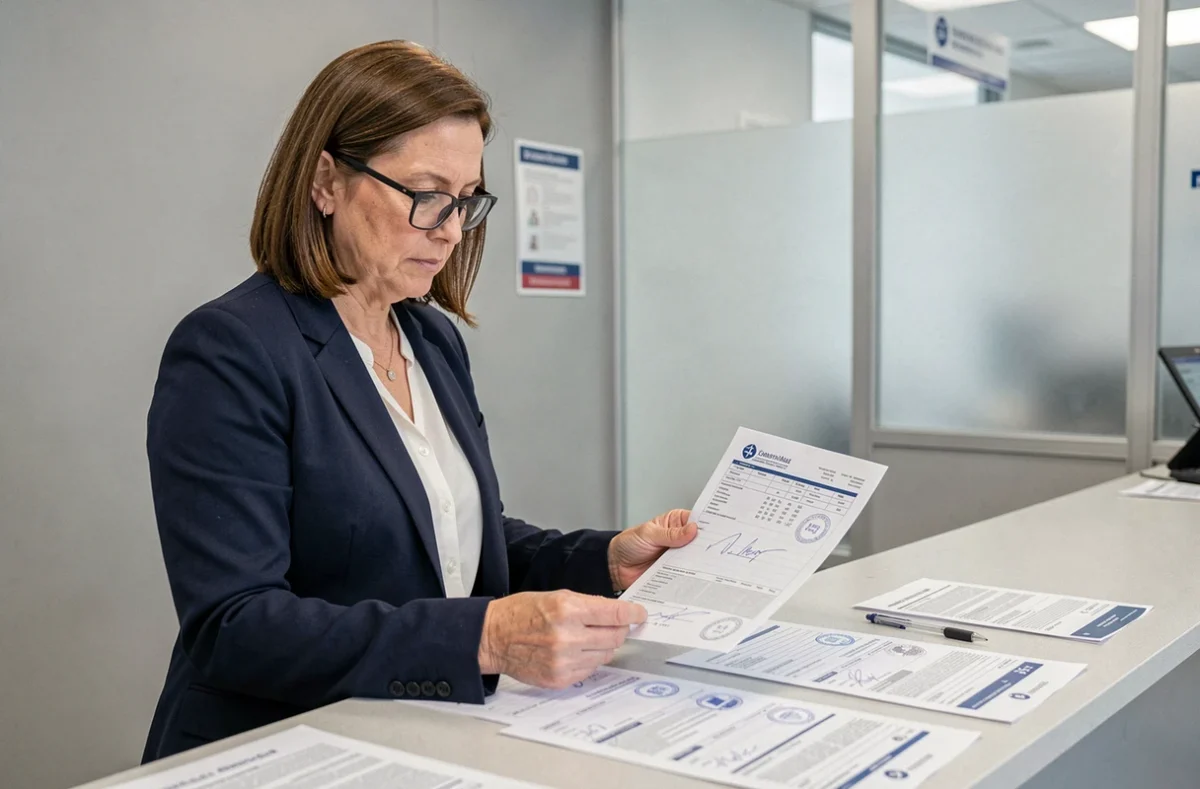
The request for a registration certificate is no longer made at the counter of a prefecture. It is processed through an online procedure or by an authorized professional. This shift changes the very nature of automotive administrative services: they are no longer limited to filling out a form, but encompass regulatory compliance checks, compatibility with local traffic restrictions, and the legal security of each transaction.
Transfer code and registration block: the mechanism that guides overlook
The declaration of transfer generates a transfer code sent to the buyer, necessary for requesting registration in their name. An error regarding the seller’s identity, the date, or the time of transfer is enough to block the process on the buyer’s side.
We regularly observe transactions stalled for several weeks because the seller entered a transfer time different from that indicated on the paper certificate. The ANTS system performs an automatic cross-check between the data declared by each party. Any inconsistency, even minor, leads to a rejection.
This point transforms the administrative service into a security function. A professional assisting with the transfer verifies the consistency of the information before validation, which avoids the ping-pong between seller and buyer once the declaration is recorded. By consulting the administrative services of Ct Automobiles, one can gauge the extent of the necessary checks for a transaction to proceed smoothly.

Registration certificate and Crit’Air sticker: two processes now linked
The Crit’Air classification is based on the data on the registration certificate, including the vehicle’s Euro standard and its type of engine. Processing the registration certificate without checking compatibility with the low emission zone (LEZ) of the buyer’s residence amounts to providing an incomplete service.
Each local authority sets its own perimeter, hours, and exemptions. A vehicle classified as Crit’Air 3 may circulate freely in one urban area and be banned in another. The professional handling the administration must therefore cross-reference the vehicle classification with the applicable local regulations.
This coupling between registration and traffic restrictions represents a change in scope for automotive service professions. Competence is no longer limited to document management: it requires regulatory monitoring of LEZs, their tightening schedules, and any temporary exemptions.
Digitalization of automotive procedures: accessibility and support
The removal of the physical counter in the prefecture has simplified the process for users comfortable with digital tools. For others, it has created an obstacle. Digital points remain in the prefecture to assist people distanced from digital technology, but their capacity is limited.
This gap opens up space for authorized professionals. A garage, a specialized service provider, or a technical control center offering administrative support meets a concrete need. It is not an ancillary service added to inflate a bill, but a function that ensures the process is completed without technical rejection.
Required skills for authorization
Authorization by the Ministry of the Interior imposes specific obligations. The professional must have access to the Vehicle Registration System (SIV) and comply with a strict framework for personal data protection. Training covers the handling of the SIV, verification of supporting documents, and the rules for billing the service.
- Secure access to the SIV with a dedicated professional identifier, traceability of each operation performed on behalf of a client
- Verification of consistency between the transfer certificate, the valid technical inspection, and the insurance certificate
- Obligation to inform the client about the cost of the regional tax, the tax on polluting vehicles if applicable, and management fees

Registration of two-wheelers and light motor vehicles: an often-overlooked angle
The regulation of motorized two-wheelers constitutes a distinct aspect that general guides rarely focus on. Mopeds, scooters, and motorcycles follow a specific registration process, with supporting documents that differ from those required for a car.
A European certificate of conformity is necessary for new vehicles. For used vehicles, the technical inspection is not required in the same way depending on the engine size. This disparity creates frequent errors during online declarations, especially when the user reflexively applies the classic automotive procedure to a two-wheeler.
Specific points of vigilance
- Mopeds under 50 cc have an identification number that does not follow the same format as a car’s VIN, leading to rejections on the platform
- The fiscal power of a two-wheeler is calculated differently, directly impacting the amount of the regional tax
- The declaration of transfer for a used scooter requires the same timestamped information as a car, with the same risk of blockage in case of inconsistency
A provider who masters the entire spectrum of vehicles (cars, vans, two-wheelers) offers a truly comprehensive administrative management. Specializing in only one type of vehicle leaves blind spots that the client discovers at the least opportune moment.
The underlying trend is clear: automotive administration absorbs additional regulatory layers every year, from LEZs to changes in the SIV. Professionals handling these procedures do not sell paperwork; they guarantee the legal validity of a transaction and the compliance of a vehicle with its traffic environment. Neglecting this dimension exposes one to blockages whose cost far exceeds that of the initial service.