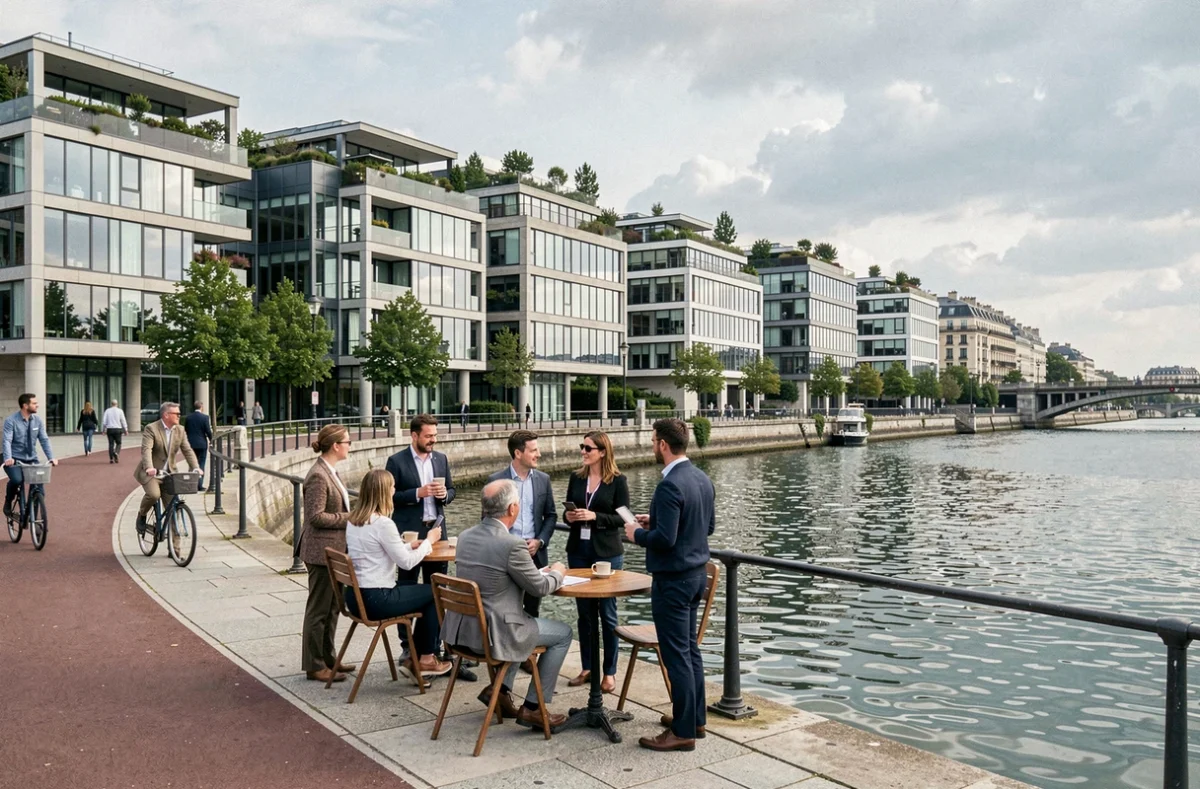
Grand Paris Seine Ouest brings together eight municipalities in Hauts-de-Seine, between the Seine loop and state-owned forests. The agglomeration currently concentrates several major projects, the timelines and financial amounts of which allow for measuring the extent of transformations underway in this territory of western Paris.
Line 15 West of the Grand Paris Express: funding figures
The most significant transport project for GPSO is not managed by the agglomeration itself, but its local impacts can be quantified. The European Investment Bank announced, on September 2, 2026, an agreement of 3 billion euros with the Société des grands projets for the western part of line 15.
This infrastructure is set to serve the Pont de Sèvres area, the gateway to the GPSO territory, with a commissioning date announced for 2031.
| Data | Value |
|---|---|
| EBI funding (line 15 West) | 3 billion euros |
| Expected commissioning | 2031 |
The scale of this European funding reflects the confidence of the lenders in the feasibility of the timeline. Detailed information on the skills and projects of the territory can be consulted at https://www.agglo-gpso.fr/, which centralizes the deliberations and urban planning documents of the public territorial establishment.

Energy transition and energy master plan of GPSO
The energy component of the agglomeration is entering an operational planning phase. The Île-de-France Region supports the development of an energy master plan for GPSO, structured around a territorial diagnosis, prospective scenarios, and an action plan.
The stated goal is the phasing out of oil and coal by 2030, coupled with a measurable reduction in overall energy consumption. This constrained timeline requires member municipalities to anticipate the renewal of their heating networks and the insulation of their built environment.
GPSO already has a local energy and climate agency (ALEC), which assists individuals and co-owners in their renovation efforts. The master plan will structure these dispersed actions into a unified roadmap, with monitoring indicators by municipality.
An underestimated lever: wastewater management
The territory is also preparing to renew its concession for the collection of wastewater and stormwater in its eight municipalities, with a new concession planned from 2028. This underground project, less visible than major transport projects, conditions the territory’s ability to absorb urban densification without saturating its networks.
The underground heritage of GPSO is old. The transition from one concession to another represents a moment of technical and financial negotiation where service levels, renewal investments, and rates are redefined for several years.
Cycling mobility: GPSO in the regional network
The cycling facilities of the agglomeration are now part of networks that extend beyond its perimeter. The Paris Region Institute indicates, in a publication dated September 18, 2026, that the Île-de-France Bicycle Network plans 11 routes totaling approximately 750 kilometers at the regional level.
For GPSO, this means that local bike paths must connect to these structuring axes. The territory borders the Seine for several kilometers, giving it a geographical advantage for east-west connections along the banks.
- The energy master plan targets the phasing out of oil and coal by 2030, with a diagnosis for each municipality
- The wastewater and stormwater concession, to be renewed in 2028, concerns all eight municipalities in the territory
- The Île-de-France Bicycle Network, with its 750 kilometers of planned routes, requires GPSO to connect its paths to regional axes
- Line 15 West, funded to the tune of 3 billion euros by the EBI, will place Pont de Sèvres at a metropolitan mobility crossroads by 2031

Eight municipalities, profile gaps not to be smoothed over
GPSO includes Boulogne-Billancourt, Issy-les-Moulineaux, Meudon, Sèvres, Chaville, Vanves, Ville-d’Avray, and Marnes-la-Coquette. Behind the institutional unity, the profiles differ significantly.
Boulogne-Billancourt and Issy-les-Moulineaux concentrate most of the tertiary and digital activity in the territory. Issy was a pioneer in the establishment of companies in the digital sector. In contrast, Chaville and Ville-d’Avray retain a residential and wooded character, with direct proximity to the state-owned forests of Meudon and Fausses-Reposes.
This heterogeneity makes inter-municipal governance more complex than it appears. Budgetary arbitrations between road investments in dense municipalities and the preservation of natural spaces in peripheral municipalities constitute a recurring exercise.
A territory labeled for biodiversity
GPSO was the first French agglomeration community referenced under the first call for recognition of the National Biodiversity Strategy, for its commitment to developing a green and blue framework plan. This label, obtained several years ago, reflects an early consideration of ecological corridors in urban planning documents.
Upcoming projects, from line 15 to the renewal of sanitation networks, will need to account for this environmental requirement. The expected densification around the future Grand Paris Express stations will test the territory’s ability to reconcile metropolitan attractiveness with the preservation of its ecological continuities.